
Published: 05:00, 17 June 2025 | Updated: 11:34, 17 June 2025
For many, it’s hard to feel too much sympathy for private schools – all too often perceived as gilt-edged seats of learning where the facilities reek of enormous investment and the opportunities are endless.
But, six months on from major changes ushered in by Chancellor Rachel Reeves and the Labour government, many in the county – and nationally – are starting to feel the pinch. The Independent Schools Council describes it as a “quadruple whammy” of additional cost pressures.

The result? A higher-than-anticipated exodus of pupils so far and the very real expectation many more will follow “until at least the next general election”. Those leaving fee-paying education are doing so across all age groups – preparatory as much as senior schools.
The impact? An influx of those students into the state system.
But KentOnline previously revealed how places at grammars – particularly in the west of the county, where private schools are most heavily concentrated – are already heavily over-subscribed. For example, 1,589 pupils applied to go to Dartford Grammar School while only 178 places were available.
While the numbers may not be overwhelming, yet – in total, private education covers just 6% of the school population – it means the rush for selective school places invariably raises the spectre of children in the state sector missing out on the perceived value of a grammar berth.
Another Kent hospital trust to axe jobs in bid to make huge savingsAnother Kent hospital trust to axe jobs in bid to make huge savings
Watch More
“The reason a lot go to private schools up to the age of 11,” explains former Gravesend Grammar head and education expert Peter Read, “is to secure grammar school places.

“The consequence for the state school system is fewer [state pupils] get in because more private school children have passed.”
He quotes around 40 children from private schools passing the Kent Test last year – about 48% of those sitting the test – then being eligible for a spot at one of the county’s 32 grammars.
“The numbers aren’t huge, but that’s 40 children in the state system who may not get a place at a grammar,” he adds, “and we can expect that to rise going forward.”
It’s not simply a case that children entering the state system at selectives from the private sector cannot be funded – each state school receives around £8,200 per pupil – it’s more that many grammar schools simply don’t have the infrastructure to handle more students. In the west of the county, pretty much all are over-subscribed.
As for children coming out midway through prep school (the equivalent of a primary), this coincides with a drop in the number of primary-aged children currently working their way through the school years. So, again, the impact is unlikely to be significant.

As one teacher, who preferred to remain anonymous, put it: “If fee-paying parents don’t get their children into a grammar, they certainly aren’t going to want them entering a non-selective. They would see that as failing their child. Plus, what would their friends think?”
So don’t expect to see any additional pressure suddenly fall upon non-selectives – however good they might be.
In an effort to cut their cloth accordingly, St Lawrence College in Ramsgate recently embarked on a consultation which could result in 20 staff – both teaching and non-teaching – being made redundant. It comes after admitting it faced a “significant” drop in revenue from September. There’s anecdotal evidence of others releasing staff too – none of those suspected of doing so would respond to KentOnline’s calls, perhaps not surprisingly.
“Over the past few years,” explains Sarah Cunnane of the Independent Schools Council (ISC), which represents 1,400 private schools, “figures in the private education sector have been fairly robust, apart from an understandable dip during Covid.
“The figures from the Department for Education released last week showed a much bigger dip. And the thing that has changed between last year and this is the introduction of VAT.

“It is the biggest drop that we have seen in over a decade, in terms of new pupils entering the sector and the biggest drop since we started collecting records in 2012.”
Much has been written about the Labour administration’s decision to introduce VAT on the sector as of January this year – a move promised in their manifesto which was part ideologically driven, part a desire to raise additional revenues for the Exchequer.
It effectively ushered in a 20% hike in fees. To combat it, many schools reduced their term costs so as to absorb some of the financial pain for parents – but that in itself means a reduction to their budgets. In almost all cases, parents still saw a sizeable additional cost.
Results
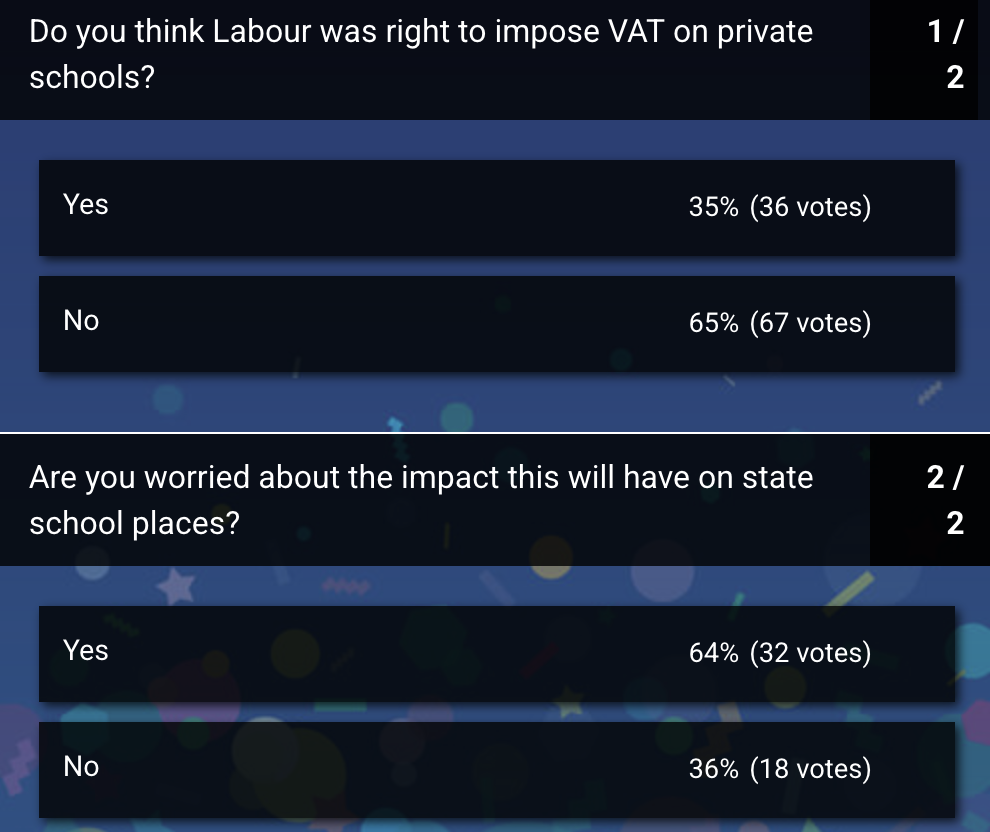
With the average fee-paying parent coughing up £18,000 per academic year for a day pupil (comfortably more than double that if they are boarding), any additional cost pressure is significant. And it is the state system which will, inevitably, feel the squeeze.
The ISC says around 13,000 pupils have already left private education this year – a figure it expects to increase after summer as parents ponder whether to pay the swollen fees.
It is the biggest drop that we have seen in over a decade
But the schools are facing more than just VAT. Hot on its heels was the end of business rates relief for those schools claiming charitable status. Previously, they had benefited from an 80% discount. Not any more.
Add to that, they were faced with the uptick in National Insurance contributions for staff and many were still feeling the pressure from a 20% increase in the Teacher Pension Scheme, introduced in April 2024.
Adds the ISC: “For some schools, it’s a quadruple whammy in terms of cost. Between two-thirds and three-quarters of outgoings at any school will be on staff costs. Schools will be doing all they can to keep everything they do intact, but there there’s only so far it can go.
“I think that actually we’re going to see this play out over several years. There will be some parents who ended things in January, and others for whom going past the current academic year will be too much. And then others who will take them out after junior school or to their GCSEs.
“September is going to give us a real sense of just how much VAT has hit the sector, but I don’t really think we’re going to see the true impact until possibly the next general election – so we’re looking to the end of the decade.”

To return to that broad brush perception of private schools which opened this article, there is also one which looks only towards the big established names – the likes of Tonbridge School and Benenden School – full of grand buildings and well-known figures among its alumni. Not to mention the thought they all sit on enormous cash reserves.
The reality is that the majority of private schools are small and impacts to their bottom line are felt hard.
Adds Sarah Cunnane from the ISC: “The majority of schools we represent are small independent day schools – usually preps with 300 pupils or less.
“Their margins are small. The government is essentially cutting their income by a fifth. It’s very difficult for any organisation to manage that.”
Yet the bigger institutions remain pretty adamant this is a temporary blip and that the sector is far more robust.

Rachel Bailey is head of Benenden School – once patronised by royalty when Queen Elizabeth II sent her daughter Anne, now the Princess Royal, there.
“The imposition of 20% VAT on fees has undoubtedly shaken the market,” she explains, “but this is a period of adjustment, not decline.
“At my school, future registrations are as healthy as ever and open day attendance is at an all-time high. Parents are looking more closely and asking sharper questions – and still choosing us. Why? Because they see the value.
“In our British habit of self-demonising, we forget all too easily that the UK independent schools sector remains a global gold standard. In fact, interest from abroad is surging. Since Donald Trump’s re-election, we’ve seen a notable rise in enquiries from American families – particularly those seeking a liberal, values-driven education.
“In the UK, demand remains strong – and this is especially true for schools that offer excellence, stability and a sense of community in uncertain times.
The imposition of 20% VAT on fees has undoubtedly shaken the market, but this is a period of adjustment, not decline
“Pupils at our schools engage fully with the world around them through partnerships with other schools and the local community. And this isn’t ‘paying lip service’, as the sector’s detractors say, it’s because it’s the right thing to do.
“Independent schools are part of the solution, not apart from it.
“So let’s stop being apologetic. The independent sector is a national success story. Yes, the market is thorny right now – but every economy has its cycles. Our schools are extraordinary. It’s time we said so – loudly, proudly, and without shame.”